
Agentic AI for B2B e-Commerce: The Next Evolution of Product Discovery

Executive Summary
B2B e-commerce is entering a new era driven by agentic AI.
Traditional e-commerce experiences were built around static catalogs, keyword search, and manual buyer research. But modern enterprise buyers increasingly expect intelligent systems that can guide discovery, answer technical questions, recommend products, automate research tasks, and help them make confident purchasing decisions faster.
This shift is creating growing interest in agentic AI: AI systems capable of reasoning, orchestrating workflows, and taking action on behalf of users.
In B2B e-commerce, agentic AI has the potential to fundamentally reshape product discovery by helping buyers navigate massive catalogs, understand compatibility requirements, compare technical products, surface trusted answers, and reduce purchasing friction.
But not all AI systems are ready for enterprise commerce.
The organizations that succeed with agentic AI will not simply deploy generic chatbots. They will build AI experiences grounded in trusted enterprise product data, hybrid search architectures, personalization, and governed AI workflows.
The future of B2B e-commerce belongs to intelligent discovery systems that help buyers confidently navigate complexity.
B2B e-Commerce Is Becoming Too Complex for Traditional Search
Modern B2B commerce environments are dramatically more complex than they were even a few years ago.
Enterprise buyers now navigate:
- massive product catalogs
- fragmented technical documentation
- contract pricing
- inventory constraints
- regulatory requirements
- compatibility relationships
- procurement workflows
- global supply chains
- configurable products
- industry-specific terminology
At the same time, buyer expectations continue rising.
Today’s enterprise customers increasingly expect:
- instant answers
- conversational discovery
- natural language interactions
- personalized recommendations
- self-service buying journeys
- intelligent product guidance
Traditional e-commerce search systems struggle to meet these expectations because they were designed primarily around keyword retrieval rather than intelligent assistance.
This is creating a major opportunity for agentic AI.
What Is Agentic AI?
Agentic AI refers to AI systems capable of performing multi-step reasoning, orchestrating workflows, and autonomously completing tasks on behalf of users.
Unlike traditional chatbots that simply generate responses, agentic AI systems can:
- gather information across systems
- reason through complex workflows
- evaluate multiple options
- maintain contextual memory
- guide decision-making
- automate repetitive tasks
- proactively assist users
In B2B commerce, this transforms AI from a passive interface into an active buying assistant.
Traditional AI vs. Agentic AI
| Traditional AI chatbots | Agentic AI systems |
|---|---|
| Single-response interactions | Multi-step reasoning |
| Limited context retention | Persistent contextual understanding |
| Reactive answers | Proactive assistance |
| Standalone interactions | Workflow orchestration |
| Generic internet knowledge | Enterprise-grounded intelligence |
| Static conversational flows | Dynamic adaptive workflows |
| Simple Q&A | Guided decision-making |
This distinction is critical for enterprise commerce.
Most B2B buying journeys are not single-question interactions. They involve complex research, validation, compatibility evaluation, procurement review, and technical decision-making.
Agentic AI is designed to support those workflows.
Why B2B e-Commerce Is a Natural Fit for Agentic AI
B2B buying processes are inherently research-heavy and information-intensive.
Buyers often need to:
- compare technical specifications
- validate compatibility
- review documentation
- evaluate alternatives
- assess compliance requirements
- analyze pricing models
- coordinate across stakeholders
- verify inventory availability
- understand implementation requirements
These workflows create ideal conditions for AI-assisted orchestration.
Common B2B Research Tasks Agentic AI Can Support
| Buyer need | Agentic AI capability |
|---|---|
| Finding compatible products | Compatibility reasoning |
| Evaluating alternatives | Comparative analysis |
| Reviewing technical documentation | AI-powered summarization |
| Navigating large catalogs | Intelligent discovery |
| Understanding specifications | Grounded AI answers |
| Identifying replacement parts | Context-aware recommendations |
| Managing procurement workflows | Workflow orchestration |
| Surfacing relevant accessories | Relationship modeling |
This dramatically reduces buyer friction.
Instead of manually navigating through dozens of pages and documents, buyers can interact with intelligent systems that guide the purchasing process.
Search Alone Is No Longer Enough
For years, e-commerce organizations focused heavily on optimizing search relevance.
That remains important.
But modern buyers increasingly expect systems that can:
- explain results
- guide decisions
- summarize information
- recommend next actions
- proactively surface relevant products
This changes the role of discovery entirely.
Search is evolving from:
- retrieval
to - intelligent orchestration.
That transition is one of the biggest shifts happening in digital commerce today.
Why Generic AI Chatbots Fail in Enterprise e-Commerce
Many organizations are rushing to deploy AI chat experiences.
Unfortunately, many of these implementations are little more than generic large language model interfaces layered onto e-commerce sites.
That creates serious enterprise risks.
Risks of Generic AI in B2B Commerce
| Generic AI systems | Enterprise-grounded AI |
|---|---|
| Public internet training data | Trusted enterprise product data |
| Hallucination risk | Higher factual accuracy |
| Weak governance | Enterprise controls |
| Generic recommendations | Catalog-aware intelligence |
| Limited explainability | Transparent sourcing |
| Weak compliance alignment | Governed enterprise workflows |
Enterprise buyers cannot rely on hallucinated recommendations.
This is especially important in industries involving:
- healthcare
- manufacturing
- industrial equipment
- energy
- infrastructure
- chemicals
- financial services
- regulated procurement
A hallucinated consumer shopping recommendation may create inconvenience.
A hallucinated industrial product recommendation may create operational or regulatory risk.
That is why grounded AI becomes essential.
Grounded AI Is the Foundation of Agentic e-Commerce
Agentic AI is only as effective as the enterprise knowledge powering it.
For B2B e-commerce organizations, that means AI systems must be grounded in:
- product catalogs
- ERP systems
- PIM platforms
- inventory systems
- technical documents
- installation manuals
- support content
- compliance documentation
- compatibility relationships
- customer-specific pricing
Without trusted grounding, AI systems cannot reliably support enterprise purchasing workflows.
Grounded AI Architecture for B2B e-Commerce
| Enterprise data source | Agentic AI value |
|---|---|
| Product catalogs | Accurate recommendations |
| Technical PDFs | Trusted AI answers |
| ERP systems | Inventory awareness |
| CRM systems | Personalization |
| PIM platforms | Product enrichment |
| Support knowledge bases | Troubleshooting guidance |
| Behavioral analytics | Relevance optimization |
This is where intelligent discovery platforms become strategically important.
The future of agentic commerce depends on unified enterprise knowledge architectures.
Hybrid Search Is Critical for Agentic AI
Many organizations mistakenly believe large language models alone are sufficient for enterprise commerce AI.
They are not.
B2B commerce requires:
- precise technical matching
- semantic understanding
- explainable recommendations
- governed retrieval
- contextual awareness
This is why hybrid search architectures are becoming foundational.
Hybrid search combines:
- lexical search
- semantic search
- vector search
- personalization
- behavioral relevance
- merchandising controls
Together, these capabilities help AI systems:
- retrieve accurate products
- understand intent
- ground responses
- improve explainability
- personalize recommendations
Without hybrid search, agentic AI systems often struggle with:
- retrieval accuracy
- technical precision
- enterprise governance
- contextual understanding
Hybrid search is increasingly becoming the retrieval layer powering enterprise AI experiences.
Agentic AI Will Transform Product Discovery
Traditional e-commerce experiences require buyers to manually perform most discovery tasks themselves.
Agentic AI changes that model.
Future commerce AI systems may help buyers:
- identify compatible products
- build product bundles
- compare suppliers
- summarize technical differences
- automate procurement research
- recommend replacements
- monitor inventory thresholds
- proactively surface alternatives
- explain compliance requirements
This creates a significantly more intelligent buying experience.
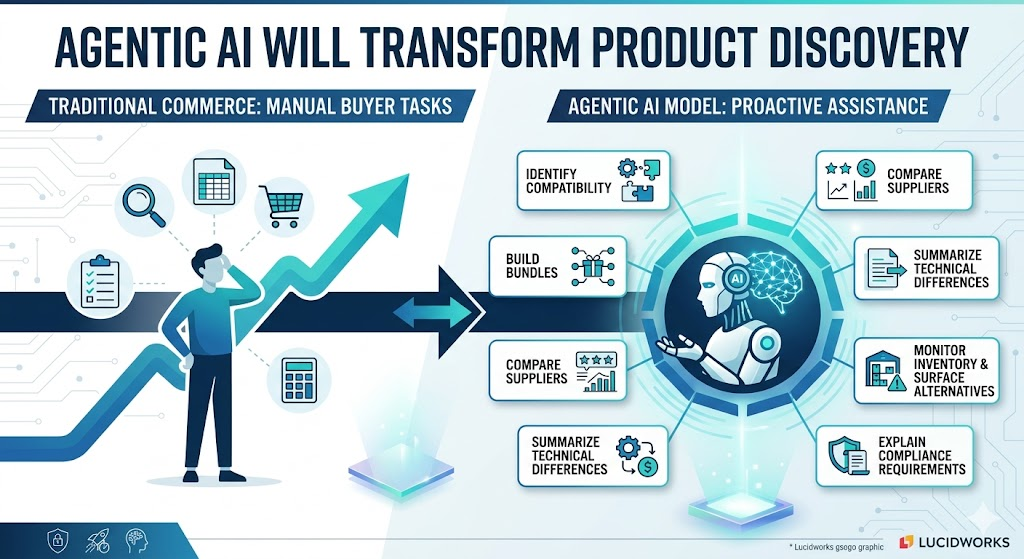
Traditional Discovery vs. Agentic Discovery
| Traditional e-commerce | Agentic commerce |
|---|---|
| Manual research | Guided discovery |
| Keyword navigation | Conversational orchestration |
| Static filters | Dynamic reasoning |
| Reactive experiences | Proactive assistance |
| Product lookup | Decision support |
| Fragmented information | Unified intelligence |
| Human-only workflows | Human + AI collaboration |
This transition represents a major strategic shift for enterprise commerce.
Personalization Will Become More Important Than Ever
As AI systems become more capable, personalization becomes increasingly valuable.
Modern B2B buyers expect experiences tailored to: contract pricing purchasing history industry context technical roles regional availability operational requirements | Agentic AI systems can leverage these signals to provide: more relevant recommendationsbetter workflow guidance role-specific assistance personalized product discovery contextual AI answers |
Examples of Agentic Personalization
| Buyer role | AI-assisted experience |
|---|---|
| Procurement manager | Contract-aware purchasing guidance |
| Engineer | Technical compatibility recommendations |
| Technician | Replacement part identification |
| Distributor | Inventory and logistics optimization |
| Healthcare buyer | Compliance-focused recommendations |
This dramatically improves buyer efficiency while reducing friction.
This dramatically improves buyer efficiency while reducing friction.
Why Explainability Matters in Enterprise AI
Consumer AI experiences often prioritize convenience over explainability.
Enterprise commerce cannot.
B2B buyers increasingly need to understand:
- why products were recommended
- what data sources informed answers
- whether results are trustworthy
- how recommendations align with requirements
This is especially important for:
- regulated industries
- procurement workflows
- technical evaluations
- compliance-sensitive environments
Enterprise AI Explainability Requirements
| Requirement | Why it matters |
|---|---|
| Transparent sourcing | Buyer trust |
| Grounded answers | Factual reliability |
| Explainable relevance | Procurement confidence |
| Governance controls | Regulatory alignment |
| Auditability | Enterprise accountability |
Organizations that ignore explainability risk weakening buyer trust.
Agentic AI Will Reshape e-Commerce Platform Evaluations

Historically, B2B commerce platform evaluations focused heavily on:
- storefront capabilities
- checkout workflows
- catalog management
- CMS features
- payment systems
That is changing rapidly.
As AI-powered discovery becomes more important, organizations increasingly evaluate:
- AI readiness
- search maturity
- hybrid retrieval architectures
- personalization capabilities
- orchestration frameworks
- grounding infrastructure
- analytics
- governance controls
This is fundamentally changing enterprise commerce priorities.
Discovery intelligence is becoming a strategic differentiator.
The Future of B2B e-Commerce Is Intelligent Orchestration
The next era of B2B commerce will not be defined solely by storefronts or catalogs.
It will be defined by intelligent systems capable of:
- understanding intent
- orchestrating workflows
- guiding decisions
- surfacing trusted knowledge
- reducing operational friction
- enabling self-service research
- accelerating purchasing confidence
This is the future of agentic commerce.
The organizations that succeed will not simply deploy AI chat interfaces.
They will build intelligent discovery ecosystems powered by:
- hybrid search
- grounded enterprise knowledge
- personalization
- orchestration
- explainability
- analytics
The future of B2B commerce belongs to organizations that help buyers confidently navigate complexity.
Key Takeaways
- Agentic AI goes beyond traditional chatbots by supporting reasoning and workflow orchestration.
- B2B commerce is an ideal environment for agentic AI because of its complexity and research-heavy workflows.
- Generic AI chatbots create major risks in enterprise commerce environments.
- Grounded AI is essential for trustworthy B2B product discovery.
- Hybrid search provides the retrieval foundation for enterprise AI experiences.
- Personalization and explainability are becoming critical differentiators.
- Product discovery is evolving from retrieval to intelligent orchestration.
Frequently Asked Questions
What is agentic AI in B2B commerce?
Agentic AI refers to AI systems capable of reasoning, orchestrating workflows, and assisting buyers through complex product discovery and purchasing tasks.
How is agentic AI different from chatbots?
Traditional chatbots primarily generate responses. Agentic AI systems can perform multi-step reasoning, maintain context, automate workflows, and proactively guide users.
Why is grounded AI important in e-commerce?
Grounded AI helps ensure that answers and recommendations are based on trusted enterprise data rather than generic internet knowledge, reducing the risk of hallucinations.
What role does hybrid search play in agentic AI?
Hybrid search combines lexical, semantic, and behavioral relevance to improve retrieval accuracy and provide trustworthy grounding for AI systems.
How can agentic AI improve B2B product discovery?
Agentic AI can help buyers compare products, identify compatible items, summarize technical documents, answer questions, and automate research workflows.
Why is explainability important in enterprise AI?
Enterprise buyers need transparency into how recommendations and answers are generated to support trust, governance, compliance, and procurement workflows.
Will agentic AI replace sales teams?
Agentic AI is more likely to augment sales and support teams by improving self-service research and reducing repetitive discovery tasks.
External Sources & Citations
Analyst Firms & Research
- Gartner
- B2B digital buying behavior research
- AI orchestration and autonomous agent trends
- Enterprise AI governance research
- B2B digital buying behavior research
- Forrester
- B2B buyer journey research
- AI-powered commerce trends
- Personalization and customer experience studies
- B2B buyer journey research
- McKinsey & Company
- Generative AI economic impact
- Digital commerce transformation
- AI-enabled operational efficiency
- Generative AI economic impact
- Deloitte Digital
- B2B commerce trends
- Enterprise AI adoption
- Digital transformation research
- B2B commerce trends
Industry Research & Commerce Sources
- IBM Research and Commerce Insights
- AI in enterprise operations
- Intelligent workflow automation
- Commerce operations modernization
- AI in enterprise operations
- Salesforce Commerce Insights
- State of connected customers
- Commerce AI trends
- Buyer expectation research
- State of connected customers
- Adobe Experience Cloud Research
- Digital commerce experience trends
- Personalization research
- B2B experience optimization
- Digital commerce experience trends
- B2B Ecommerce Association
- B2B ecommerce market trends
- Buyer behavior research
- Digital commerce adoption insights
- B2B ecommerce market trends
Editorial note: This is a post within a series of posts about enterprise search and AI within B2B commerce organizations. The other posts in the series can be found here:
https://lucidworks.com/blog/the-future-of-b2b-commerce-is-ai-powered-product-discovery
https://lucidworks.com/blog/why-b2b-ecommerce-search-fails-modern-buyers